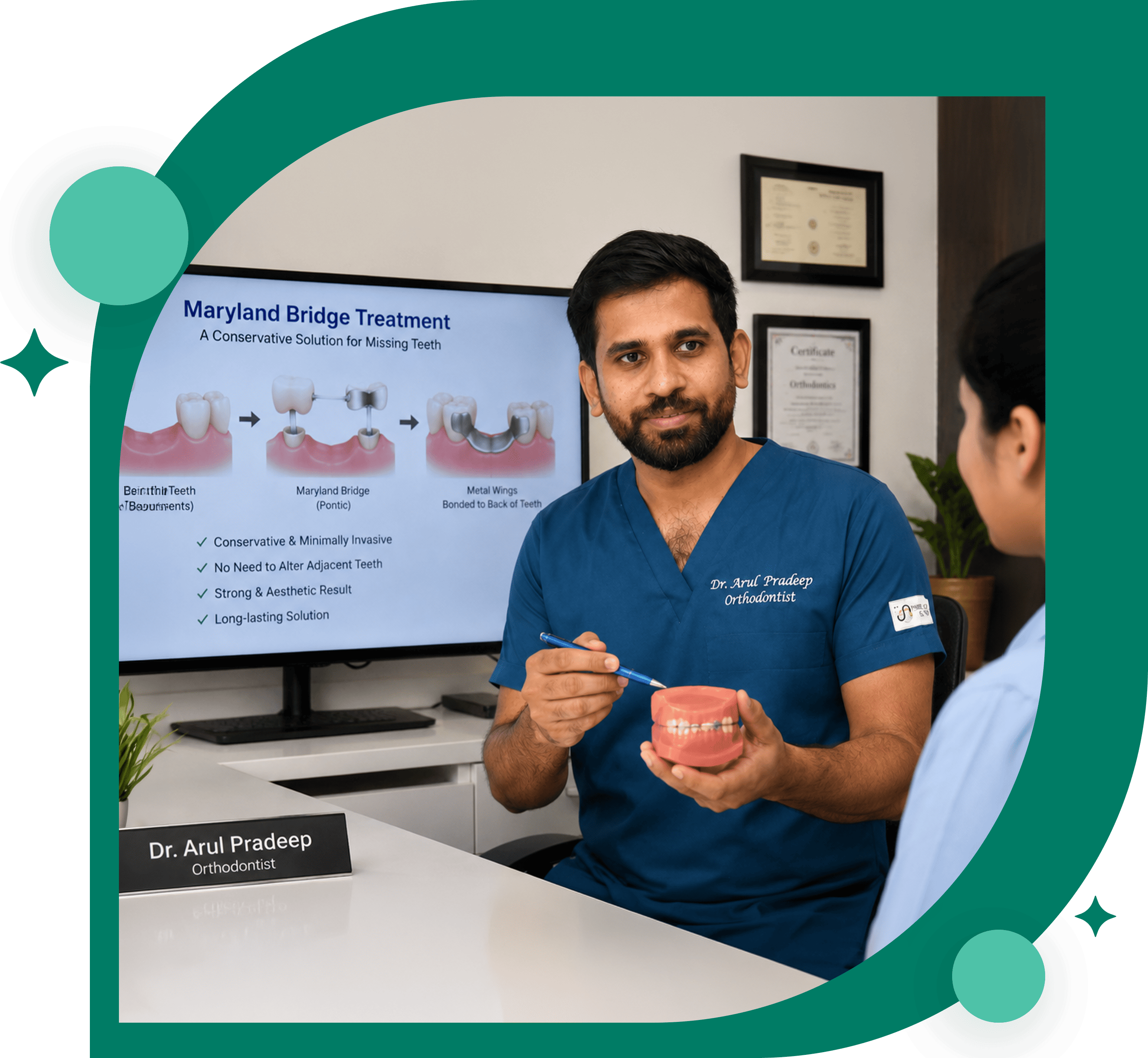
Conservative Tooth Replacement with Minimal Intervention
A Maryland bridge is a minimally invasive solution used to replace a missing tooth — primarily in the front region — while preserving the natural structure of adjacent teeth. Unlike conventional bridges, this technique avoids extensive tooth reduction and focuses on conservative, aesthetic restoration.
A Maryland bridge (also known as a resin-bonded bridge) consists of :
1. Metal Framework Maryland Bridge
2. Porcelain-Fused-to-Metal (PFM) Maryland Bridge
3. All-Ceramic / Zirconia Maryland Bridge
4. Fiber-Reinforced Composite Bridge
Maryland bridges are suitable for:
Each case is carefully evaluated to ensure suitability.
| Factor | Maryland Bridge | Conventional Bridge |
|---|---|---|
| Tooth Preparation | Minimal | Significant (crowns required) |
| Invasiveness | Conservative | More invasive |
| Strength | Moderate | High |
| Aesthetics | High (esp. zirconia) | High |
| Longevity | Moderate | Long-term |
| Factor | Maryland Bridge | Dental Implant |
|---|---|---|
| Surgery Required | No | Yes |
| Tooth Preservation | Yes | Yes |
| Treatment Time | Short | Longer |
| Cost | Moderate | Higher |
| Longevity | Moderate | Long-term (very high) |
| Factor | Maryland Bridge | Removable Denture |
|---|---|---|
| Stability | Fixed | Removable |
| Comfort | High | Moderate |
| Aesthetics | Better | Variable |
| Maintenance | Easy | Requires removal |
The emphasis of treatment is on:
A detailed consultation will help determine:
A Maryland Bridge is a conservative tooth replacement option used to replace a missing tooth, especially in the front teeth region. It consists of an artificial tooth supported by small wings bonded to the back of adjacent natural teeth.
Maryland Bridges are commonly recommended for:
Unlike conventional bridges, Maryland Bridges usually require minimal or no cutting of adjacent teeth. They are bonded conservatively to the natural teeth using metal or ceramic wings.
Maryland Bridges can serve as both a medium- to long-term solution depending on case selection and care. However, they are often considered more conservative compared to implants and may be used as a transitional or definitive option based on individual needs.
No. The procedure is usually comfortable and minimally invasive, often requiring little to no anesthesia
Patients may experience a short adjustment period as they get used to the restoration. Mild sensitivity, if present, is usually temporary and resolves quickly.
With proper oral hygiene and care, a Maryland Bridge can last several years. Longevity depends on bite forces, oral habits, and maintenance.
In some cases, the bonded wings may loosen over time due to biting forces or habits. If this occurs, the bridge can often be re-bonded or adjusted by the dentist.
Maryland Bridges are most commonly used for front teeth because back teeth experience stronger biting forces that may reduce long-term stability.
Yes. Once adapted, Maryland Bridges are designed to feel comfortable and function naturally during speaking and light to moderate chewing.
Both options have advantages. Dental implants are more permanent and independent, while Maryland Bridges are more conservative and may be suitable when implants are not immediately possible. The ideal treatment depends on the patient’s age, bone condition, and oral health.
Proper maintenance helps improve the longevity and stability of the restoration.
The cost depends on the materials used, complexity of the case, and aesthetic requirements. A detailed consultation will provide a personalised treatment plan along with a clear and transparent estimate.
Schedule your consultation and explore solutions tailored to your needs.