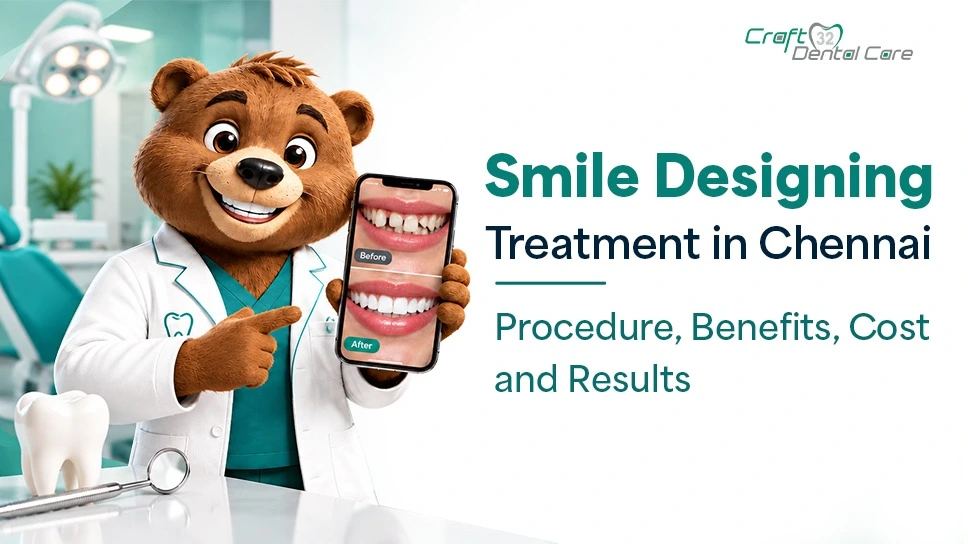
Your Teeth Are Healthy, But Your Smile Still Bothers You
Many people visit a dentist, hear that their teeth are in good shape, and leave feeling a little confused. Their teeth are cavity-free, their gums are healthy and yet something about the way their smile looks still makes them self-conscious.
It might be the colour. Or the way one tooth sits slightly higher than the others. Or a gap that has always been there. Or a gummy smile that makes them cover their mouth in photos.
This is where smile designing comes in.
Smile designing treatment in Chennai is one of the most sought-after cosmetic dental services today not because people want dramatic transformations, but because they want a smile that feels like theirs. Proportionate. Natural. In harmony with their face.
This article explains what smile designing treatment involves, how it works, what it can address, how long it takes, and what it realistically costs in Chennai.
What Is Smile Designing Treatment?
Smile designing is a personalized approach to improving the appearance of your smile. Rather than focusing on a single tooth or a single problem, it looks at the bigger picture, how your teeth relate to your gums, lips, and overall facial structure.
A proper smile design evaluation considers:
- Tooth shape and size
- Tooth proportions relative to each other
- Tooth colour and translucency
- Alignment and spacing
- Gum levels and symmetry
- Your smile line how much tooth shows when you smile
- Lip position and movement
- Facial symmetry and facial proportions
Because every face is different, there is no standard template. The same veneer shape that suits one patient may look artificial on another. A well-designed smile should complement who you already are, not replace it with something generic.
Importantly, smile design is not a single procedure. It is a treatment plan. Depending on your concerns and clinical assessment, it may involve one treatment or a carefully planned combination of cosmetic, orthodontic, and restorative procedures.
What Problems Can Smile Designing Correct?
Smile designing can address a wide range of aesthetic concerns, including:
- Chipped or broken teeth
- Worn-down teeth
- Uneven tooth shapes or sizes
- Gaps between teeth
- Discoloured or stained teeth that don't respond well to whitening alone
- Mildly misaligned or crowded teeth
- Uneven gum levels
- Excessive gum display (sometimes called a gummy smile)
- Teeth that appear too small or disproportionate
- Asymmetrical smiles
The appropriate treatment for each of these concerns depends on your oral health, the structure of your teeth, and your overall bite. This is why a clinical examination is always the starting point not a price list.
How Does Digital Smile Designing Work?
Digital smile designing brings an additional layer of precision to cosmetic treatment planning.
Using high-quality clinical photographs, intraoral scans, and specialized software, your dentist can analyse the relationship between your teeth, gums, lips, and face in detail. This process helps identify proportions, asymmetries, and opportunities for improvement that might not be as obvious in a standard examination.
One of the practical advantages of digital planning is that it allows you to see the proposed direction of your treatment before certain procedures begin. This makes it easier to discuss expectations, refine the design, and ensure both you and your dentist are aligned before any irreversible steps are taken.
It is worth noting that digital simulations represent a planning tool, not a guaranteed preview of the final result. Final outcomes depend on the materials used, the procedures involved, and individual biological factors.
Digital smile design in Chennai is increasingly available at specialist-led clinics that invest in advanced technology, and it significantly improves the communication between patient and clinician throughout treatment.
Smile Designing Procedure: Step by Step
Understanding what to expect can make the process feel far less daunting.
- Step 1: Smile Consultation Your dentist takes time to understand what concerns you, what changes you are hoping for, and what your expectations are. This conversation shapes everything that follows.
- Step 2: Dental and Facial Assessment A thorough clinical examination evaluates your teeth, gums, bite, bone health, tooth proportions, smile line, and how your lips move when you speak and smile. This is where the clinical picture is formed.
- Step 3: Digital Records and Smile Planning Photographs, scans, and measurements are taken. Where digital smile designing tools are used, these records form the basis of your personalised smile analysis and treatment visualisation.
- Step 4: Personalised Treatment Plan Your dentist presents a treatment plan tailored to your concerns and clinical needs. This may involve teeth whitening, composite bonding, ceramic veneers, gum contouring, orthodontic treatment, or a combination of these sequenced in the right clinical order.
- Step 5: Treatment Phase Treatment begins based on the agreed plan. The number of appointments and overall duration depends on which procedures are involved.
- Step 6: Final Refinement and Review Once treatment is complete, your dentist reviews tooth proportions, shade, symmetry, bite, and overall harmony with your facial features. Minor adjustments may be made at this stage.
- Step 7: Maintenance and Follow-Up You receive guidance on how to care for your results including oral hygiene advice, maintenance appointments, and any specific care recommendations for the treatments you have had.
What Treatments May Be Included in Smile Designing?
Teeth Whitening
Professional teeth whitening is often one of the first steps when discolouration or staining is a concern. It is conservative, non-invasive, and can significantly improve tooth shade though results vary depending on the type and cause of the staining.
Composite Bonding
Tooth-coloured composite resin can be applied and shaped directly onto the tooth surface to correct minor chips, small gaps, uneven edges, and surface irregularities. It is a versatile and relatively conservative option that can often be completed in a single appointment.
Ceramic Veneers
Porcelain or ceramic veneers are thin shells bonded to the front surface of the teeth. They can improve tooth shape, colour, proportions, and symmetry across multiple teeth simultaneously. The degree of tooth preparation required varies case by case some veneers require minimal preparation, while others may require slightly more, depending on the starting position of the teeth and the desired outcome.
Gum Contouring
Uneven gum lines or excessive gum display can affect the overall balance of a smile. Gum contouring reshapes the gum tissue to create a more symmetrical and proportionate appearance. It is often part of a broader smile design plan rather than a standalone treatment.
Clear Aligners or Orthodontic Treatment
When teeth are misaligned, crowded, or when the bite needs correction, orthodontic treatment may be recommended before cosmetic procedures are carried out. Attempting to place veneers on poorly positioned teeth rarely produces a natural-looking or long-lasting result. Clear aligners such as Invisalign offer a discreet way to address alignment concerns as part of a staged smile design plan.
Crowns or Restorative Treatment
When a tooth is heavily damaged, fractured, or structurally compromised, cosmetic treatment alone may not be sufficient. In these situations, a crown or other restorative treatment may be required to restore both the appearance and the function of the tooth before or alongside cosmetic work.
Benefits of Smile Designing Treatment
Patients who undergo smile designing treatment often describe benefits that go beyond appearance alone:
- More balanced and proportionate tooth shapes
- Greater symmetry across the smile
- Better harmony between teeth, gums, lips and face
- A result that is personalised rather than template-based
- The ability to address multiple concerns through a single coordinated plan
- Digital planning tools that improve communication and expectation-setting
- Conservative treatment options where clinically appropriate
- Increased confidence in everyday situations whether at work, in photos, or in conversation
These benefits are realistic and meaningful but they are also dependent on a thorough assessment and a well-executed treatment plan.
Who Is a Good Candidate for Smile Designing?
Smile designing is suitable for adults who are unhappy with the appearance of their smile and have realistic expectations about what treatment can achieve.
However, before any cosmetic treatment begins, underlying dental conditions need to be addressed. These include:
- Active tooth decay
- Gum disease
- Dental infections
- Significant bite problems that could affect the long-term stability of cosmetic work
Cosmetic treatment on an unhealthy foundation is unlikely to produce lasting results. Ensuring dental health comes first is not a delay, it is a necessary part of producing a result that lasts.
Suitability for specific treatments within a smile design plan always depends on individual clinical factors and should be assessed by a qualified dentist.
How Long Does Smile Designing Treatment Take?
There is no single answer to this question, because it depends entirely on which treatments are involved.
- Teeth whitening or minor composite bonding may be completed within a small number of appointments.
- Ceramic veneers typically require multiple appointments covering planning, preparation, temporary placement, and final bonding.
- Orthodontic or clear aligner treatment may take several months to over a year, depending on the complexity of tooth movement required.
- A comprehensive smile makeover involving several procedures may be planned in stages over an extended period.
Your dentist will give you a realistic timeline as part of your treatment plan one that accounts for the sequence in which procedures need to be carried out and any healing periods between stages.
Smile Designing Treatment Cost in Chennai
This is one of the most common questions people ask before their consultation and a fair one.
The honest answer is that there is no fixed cost for smile designing treatment in Chennai, because smile designing is not a fixed treatment. It is a personalized plan.
The final cost depends on a number of factors:
- The number of teeth being treated
- Which treatments are required (whitening, bonding, veneers, orthodontics, gum contouring, restorative treatment)
- Whether composite or ceramic materials are used
- The complexity of your case
- The number of appointments involved
- Whether orthodontic treatment is needed before cosmetic procedures can begin
Smile makeover cost in Chennai varies considerably from patient to patient for these reasons. A treatment plan involving two composite bonded teeth is very different in scope and cost from a full ceramic veneer case combined with gum contouring and aligner treatment.
The most accurate estimate of your smile designing cost in Chennai can only be provided after a clinical examination, dental records, and a review of what your teeth actually need. Clinics that quote prices without seeing you first are working without essential information.
Smile Designing Before and After: What Results Can You Expect?
Smile designing before and after photographs can be a helpful reference point but it is important to understand that your results will be unique to you.
Outcomes depend on:
- The starting condition of your teeth and gums
- Your facial proportions and lip dynamics
- The treatments chosen
- The materials used
- Your oral hygiene and maintenance habits
- Your individual biology and how your tissues respond
The goal of good smile design is not to give every patient the same smile. It is to improve your specific aesthetic concerns in a way that looks natural, suits your face, and complements your existing features. Aiming for a result that looks "done" or artificial is considered poor design.
How Long Do Smile Designing Results Last?
Longevity varies depending on the treatments involved and how well they are maintained.
- Whitening results can be maintained with good oral hygiene and periodic touch-ups, but teeth naturally tend to shade over time.
- Composite bonding may require polishing, minor repairs, or replacement over the years, particularly if you grind your teeth or have certain dietary habits.
- Ceramic veneers can last for many years with proper care, but they are not permanent for life and may eventually need replacing.
- Orthodontic results require retention usually in the form of retainers to remain stable long term.
Regular dental check-ups and good daily oral hygiene are the most reliable ways to protect your investment in cosmetic treatment.
Smile Designing vs Smile Makeover: Is There a Difference?
The two terms are often used interchangeably, and in most clinical conversations they refer to the same broad process.
If there is a nuanced distinction, it is this: "smile design" tends to emphasise the planning and analysis phase the evaluation of proportions, aesthetics, and treatment sequencing. "Smile makeover" is more commonly used to describe the overall combination of treatments carried out to achieve the planned result.
Neither term is more correct than the other, and different clinics and clinicians may use them differently. What matters more than the terminology is the quality of the planning behind the treatment.
Why Personalised Smile Design Matters
It can be tempting to point to a celebrity's smile and say, "I want that." And while inspiration is useful, directly copying a smile from another face rarely works because that smile was designed for a different face.
A well-executed smile design considers your face shape, skin tone, age, lip position and movement, existing tooth structure, gum display, and the proportions that already exist in your facial features. It accounts for what is clinically achievable given your specific teeth and bone structure. And it takes your preferences seriously because ultimately, the result has to feel right to you.
Applying the same veneer shape, width, or shade to every patient is the opposite of personalised design. It produces smiles that look similar to each other but disconnected from the individuals wearing them.
Good smile design is invisible in the best possible sense. The result looks like a natural part of you, not like a cosmetic procedure.
Smile Designing at Craft 32 Dental Care, Chennai
At Craft 32 Dental Care, smile design begins with understanding each patient's concerns and expectations before any treatment is proposed.
The process involves a thorough evaluation of tooth proportions, gum aesthetics, smile line, lip dynamics, and facial harmony, not just a review of the teeth in isolation. Digital records and smile planning tools are used where clinically appropriate, allowing treatment to be visualised and refined before certain procedures begin.
Treatments offered as part of smile design at Craft 32 include ceramic veneers, composite bonding, teeth whitening, gum contouring, Invisalign and clear aligners, and restorative treatment where the clinical situation requires it. A minimally invasive approach is applied wherever it is clinically sound to do so.
Dr. A. Arul Pradeep, MDS specialist in Advanced Orthodontics and Cosmetic Dentistry, brings a combined perspective to smile design, one that considers both the functional and aesthetic dimensions of each case.
If you are considering smile designing treatment in Chennai, a consultation can help determine which treatments are appropriate for your teeth, your facial features, and your desired outcome.
Frequently Asked Questions
Conclusion
Smile designing is not about chasing an idealised or borrowed smile. It is about understanding what specifically bothers you about your own smile and creating a realistic, personalised plan to address it.
Done well, the result should look natural, feel comfortable, and work in harmony with your teeth, gums, lips, and face. It should improve your confidence without signalling that you have had cosmetic work done.
Whether your concerns are cosmetic, structural, or somewhere between the two and whether treatment involves a single procedure or a staged combination the foundation of good smile design is always the same: thorough assessment, careful planning, and clinical honesty about what is achievable.
If you are considering smile designing treatment in Chennai, the best next step is a consultation at Craft 32 Dental Care, where your smile can be evaluated in full and a treatment plan can be built around your individual clinical needs, facial features, and expectations.