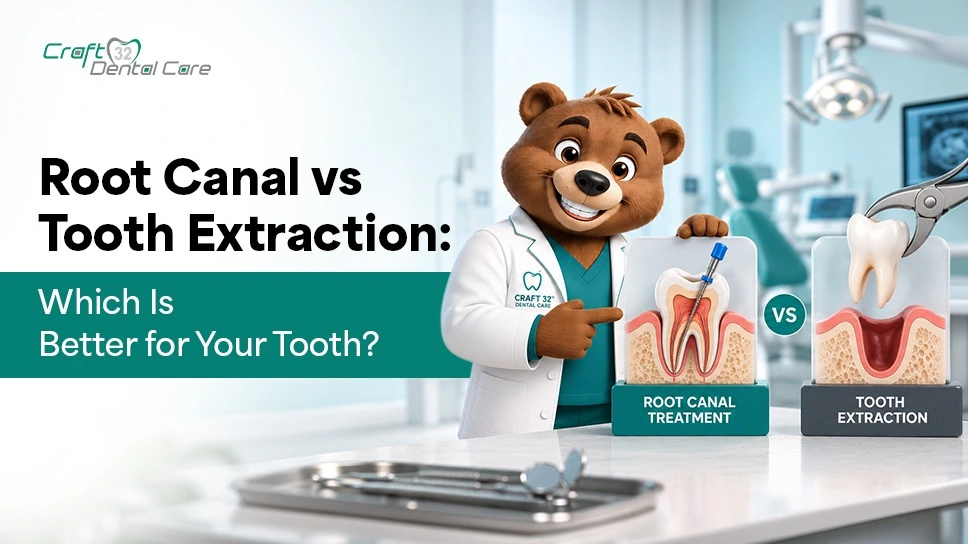
You're sitting in the dental chair, and your dentist tells you that your tooth is in trouble. The options on the table: a root canal treatment or a tooth extraction. Both sound daunting, and it's natural to wonder which one is the right call.
The truth is, this isn't a one-size-fits-all decision. The choice between root canal vs tooth extraction depends on the condition of your tooth, the extent of the infection or damage, and a proper clinical examination. What this article will do is help you understand both procedures clearly, so you can walk into your dentist's office informed and confident.
What Is a Root Canal Treatment?
A root canal treatment is a procedure designed to save a tooth that has been severely damaged or infected from the inside. Inside every tooth, beneath the hard enamel and the layer of dentin, there is a soft tissue called the pulp. This pulp contains nerves, blood vessels, and connective tissue. When bacteria reach the pulp due to deep decay, a crack, or repeated dental work, the pulp can become inflamed or infected.
During a root canal procedure, the dentist removes the infected or damaged pulp, cleans and disinfects the hollow canals inside the root, and seals the tooth with a filling material. In most cases, a dental crown is placed over the treated tooth to restore its strength and protect it from future damage.
The goal of a root canal is straightforward: to remove the source of infection while preserving your natural tooth.
What Is Tooth Extraction?
A tooth extraction is the complete removal of a tooth from its socket in the jawbone. There are two main types: a simple extraction, where a tooth that is visible above the gumline is removed, and a surgical extraction, which involves removing a tooth that may be broken at the gumline or has not fully erupted.
Extraction is typically recommended when a tooth is too badly damaged or decayed to be saved, when there is advanced bone loss due to gum disease, when the tooth is fractured below the gumline, or when space needs to be created as part of orthodontic treatment. Wisdom tooth removal is probably the most common example of a planned extraction.
Root Canal vs Tooth Extraction: What's the Difference?
Here is a straightforward comparison across the factors that matter most to patients:
| Factor | Root Canal Treatment | Tooth Extraction |
|---|---|---|
| What it does | Saves the natural tooth | Removes the tooth entirely |
| Procedure | Pulp removal, cleaning, sealing, crown | Tooth removed from socket |
| When recommended | Infected or damaged pulp, salvageable tooth | Severely damaged, non-restorable tooth |
| Pain during procedure | Minimal, performed under local anaesthesia | Minimal, performed under local anaesthesia |
| Recovery time | 1 to 3 days of mild soreness | 3 to 7 days, possibly longer for surgical extraction |
| Treatment visits | Typically 1 to 2 visits | Usually 1 visit |
| Long-term impact | Preserves natural tooth and bite function | Gap in jaw; replacement needed to restore function |
| Cost consideration | Higher upfront, but avoids replacement cost | Lower initially, but replacement adds cost later |
| Follow-up required | Crown placement usually needed | Implant, bridge, or denture if replacing the tooth |
| Effect on adjacent teeth | No shifting of surrounding teeth | Missing tooth can cause surrounding teeth to shift |
When Is a Root Canal the Better Option?
A root canal is generally the preferred option when the tooth is still structurally intact enough to be saved. Specifically, a root canal is usually recommended when:
- The pulp is infected or inflamed due to deep decay
- There is an abscess or collection of pus at the root tip
- The tooth has cracked or been injured but the roots and surrounding bone are health
- The patient wants to preserve their natural tooth for functional or aesthetic reasons
Keeping a natural tooth is almost always the first priority in modern dentistry. A natural tooth performs better than any replacement. It distributes biting force more naturally, maintains the integrity of the jawbone, and helps prevent the adjacent teeth from shifting out of position over time.
When Is Tooth Extraction Necessary?
There are situations where saving a tooth simply is not clinically possible, and extraction becomes the appropriate course of action:
- The tooth is fractured through the root and cannot be structurally restored
- Decay has destroyed too much of the tooth structure to support a crown
- Advanced periodontal (gum) disease has caused significant bone loss around the tooth
- The infection is severe and has spread to surrounding bone in a way that cannot be managed with root canal treatment alone
- The tooth is a problematic wisdom tooth causing crowding, infection, or impaction
Extraction may also be considered when the cost and complexity of saving a tooth makes it impractical relative to the tooth's long-term prognosis.
Root Canal vs Tooth Extraction: Which One Should You Choose?
This is the question most patients want answered directly, and it deserves an honest response.
There is no universal answer. The right choice between a root canal and a tooth extraction depends entirely on the clinical condition of your tooth. A dentist cannot make this determination from a description of symptoms alone. A thorough examination, which typically includes dental X-rays to assess the root structure and surrounding bone, is necessary before any treatment recommendation can be made.
What is worth understanding is that where a root canal is feasible, most dentists will recommend it. The natural tooth is almost always the better long-term outcome, both in terms of function and oral health. Extraction is recommended when saving the tooth is no longer a realistic clinical option, not simply because it may be quicker or less expensive at the outset.
If you are weighing these options, the most important step is to consult a qualified dentist for a proper assessment.
Can a Root Canal Save a Tooth That Would Otherwise Need Extraction?
In many cases, yes. A root canal can save a tooth that would otherwise need to be extracted, provided the roots are intact, there is sufficient healthy tooth structure remaining, and the surrounding bone and gum tissue are in reasonable condition.
This is precisely why root canal treatment exists as a procedure. It addresses the internal problem, the infected or damaged pulp, while leaving the external structure of the tooth in place. Once the infection is cleared and the tooth is sealed and crowned, it can continue to function for many years with proper oral care.
The key is timing. Teeth that might have been saved with a root canal can become non-restorable if the infection progresses significantly or if the tooth structure deteriorates beyond a recoverable point. This is why early examination matters.
What Happens After Tooth Extraction?
Once a tooth is extracted, the gap it leaves does not simply resolve on its own. Left unfilled, the space can lead to shifting of the adjacent and opposing teeth, changes in the bite, bone loss in the jaw at the site of the missing tooth, and aesthetic concerns depending on where the gap is located.
For these reasons, most dentists recommend replacing a missing tooth after extraction. The common options include:
- Dental Implant: A titanium post surgically placed into the jawbone, which functions as an artificial tooth root. A crown is placed on top. This is considered the closest replacement to a natural tooth.
- Dental Bridge: An artificial tooth anchored to the adjacent natural teeth on either side. No surgery is required, but the neighbouring teeth need to be prepared to support the bridge.
- Removable Denture: A partial or full removable appliance that fills the gap. Generally the most affordable option, though it requires more adjustment in daily use.
The right replacement option depends on the location of the missing tooth, the health of the surrounding teeth and bone, and the patient's preferences and budget.
Is Root Canal Treatment Painful?
This is one of the most common concerns patients have, and it is worth addressing clearly. Root canal treatment has a reputation for being painful that simply does not reflect the reality of modern dental practice.
The procedure is carried out under local anaesthesia, which numbs the tooth and the surrounding area completely. Most patients report that the procedure itself is no more uncomfortable than having a regular filling placed. The discomfort that patients sometimes associate with a root canal is generally the pain from the infection that preceded the treatment, not the treatment itself.
After the procedure, some mild soreness or tenderness around the area is normal for a few days. This is typically manageable with over-the-counter pain relief and usually resolves quickly. Your dentist will advise you on appropriate post-treatment care.
How Much Does Root Canal Treatment Cost in Chennai?
The cost of root canal treatment in Chennai is not fixed. It varies based on several clinical and procedural factors:
- Which tooth is being treated: Front teeth typically have one root canal, while premolars and molars may have two to four. More canals generally means more time and complexity.
- Severity of the infection: More advanced infections may require additional visits or preparatory treatment.
- Number of sittings: Some cases are completed in one sitting; others require two or more.
- Whether a dental crown is needed: A crown is almost always recommended after a root canal, and the type of crown (ceramic, zirconia, metal-fused) affects the overall cost.
- The clinic and technology used: Clinics using advanced equipment such as rotary endodontic instruments or operating microscopes may have different fee structures.
For an accurate cost estimate for your specific situation, a clinical examination at Craft 32 Dental is the only way to get a personalised treatment plan and transparent pricing.
What Happens If You Delay Treatment?
If a tooth that needs a root canal is left untreated, the infection within the pulp does not remain contained. Over time, it can progress in ways that are clinically significant:
- The infection can spread to the surrounding bone, causing a dental abscess
- The bone supporting the tooth may begin to deteriorate
- Adjacent teeth may be affected as the infection spreads
- What was once a treatable tooth may become non-restorable, making extraction unavoidable
- In some cases, the spread of dental infection can lead to more serious health concerns that require prompt medical attention
Delaying treatment does not make the underlying problem better. If your dentist has recommended a root canal, addressing it promptly gives you the best chance of saving the tooth and avoiding more complex treatment later.
Common Questions
Final Takeaway
The debate between root canal vs tooth extraction is not really about which procedure is better in the abstract. It is about what is right for your specific tooth, at this specific point in time.
Where a root canal is clinically appropriate, it gives you the opportunity to keep your natural tooth. That is almost always worth pursuing. When a tooth is beyond saving, extraction followed by a well-planned replacement is the responsible path forward.
At Craft 32 Dental, every treatment recommendation begins with a thorough examination and, where needed, dental X-rays, because there is no responsible shortcut to understanding what your tooth actually needs. If you are experiencing tooth pain, sensitivity, swelling, or have been told you may need a root canal or extraction, the right next step is to see a qualified dentist for a personalised assessment.