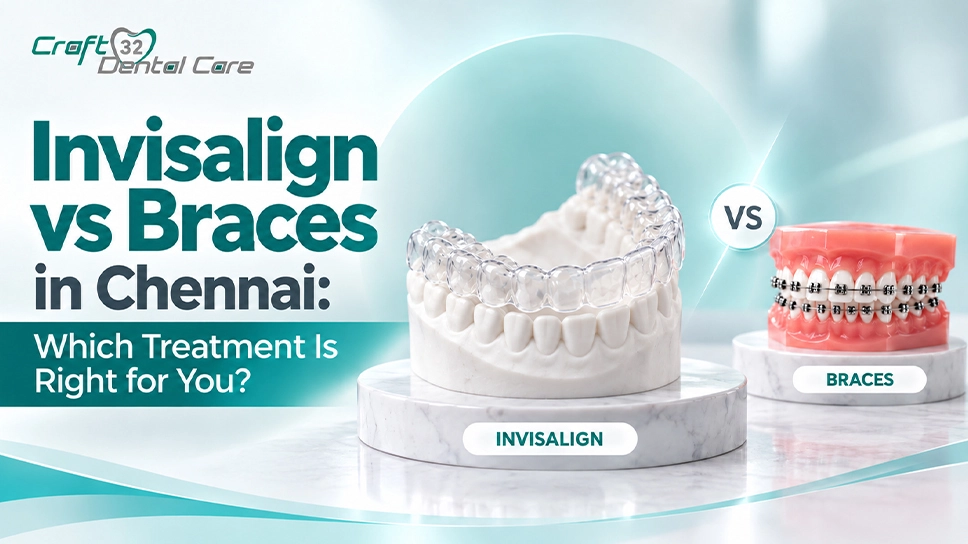
Should I choose Invisalign or braces?
It is one of the first questions many people ask when they decide to straighten their teeth. Invisalign is discreet and removable, while traditional braces remain a widely used option for correcting many types of orthodontic problems.
But appearance should not be the only factor influencing your decision.
When comparing Invisalign vs braces in Chennai, the right treatment depends on your tooth alignment, bite, complexity of movement required, lifestyle, age, ability to follow treatment instructions, budget and long-term treatment goals.
Some patients may be suitable candidates for either option. Others may benefit more from a particular orthodontic approach based on their clinical needs.
This guide explains how Invisalign and braces work, their practical differences, treatment considerations and what an orthodontist evaluates before recommending an option.
How Does Invisalign Work?
Invisalign uses a series of custom-made clear aligners to gradually move teeth towards planned positions.
Treatment usually begins with an orthodontic assessment and digital records. A digital model of the teeth can then be used to plan the required movements and create a sequence of aligners.
Each set of aligners is worn according to the orthodontist's instructions before progressing to the next stage.
Unlike fixed braces, Invisalign trays can be removed for eating, brushing and flossing.
However, being removable also means treatment relies heavily on patient compliance. Aligners generally need to be worn for most of the day, commonly around 20 to 22 hours, or according to your orthodontist's specific instructions.
Invisalign may be considered for concerns including:
- Crowded teeth
- Gaps between teeth
- Crooked teeth
- Certain overbites
- Certain underbites
- Crossbites
- Some open-bite problems
The suitability of clear aligners depends on the complexity of the case and the type of tooth movement required.
Patients interested in removable orthodontics can learn more about Invisalign and clear aligners in Chennai and how digital treatment planning is used at Craft 32 Dental Care.
How Do Traditional Braces Work?
Traditional braces straighten teeth using brackets attached to the teeth and orthodontic wires that apply controlled forces.
Unlike clear aligners, braces remain fixed to the teeth throughout active treatment.
The orthodontist adjusts or changes components at scheduled appointments so that teeth gradually move according to the treatment plan.
Several types of braces may be available, including:
- Conventional metal braces
- Ceramic braces
- Other fixed orthodontic systems depending on clinical requirements
Metal braces are more visible, while tooth-coloured ceramic options can provide a less noticeable appearance for some patients.
One important advantage of fixed appliances is that they do not depend on the patient remembering to wear them each day.
Braces can also provide an orthodontist with precise control over many types of tooth movement, which can be useful in certain moderate or complex cases.
Patients can explore the different options available for orthodontic treatment in Chennai before deciding which approach may suit their needs.
Invisalign vs Braces in Chennai Comparison
There is no universal winner when comparing clear aligners vs braces. Each option has practical advantages and limitations.
Here is a simple comparison.
| Factor | Invisalign | Braces |
|---|---|---|
| Appearance | Clear and relatively discreet | Metal braces are visible, while ceramic options are less noticeable |
| Removability | Removable | Fixed to the teeth |
| Eating | Removed during meals | Certain hard, sticky and chewy foods may need to be avoided |
| Oral hygiene | Aligners can be removed for brushing and flossing | Cleaning around brackets and wires requires additional attention |
| Comfort | Smooth trays, although pressure and temporary tenderness can occur | Brackets and wires may initially irritate the cheeks or lips |
| Discipline required | High, because aligners must be worn consistently | Lower daily compliance because appliances remain fixed |
| Clinic visits | Regular monitoring is required | Regular orthodontic adjustments are required |
| Complex tooth movement | Suitable for many cases, depending on complexity | May offer greater control for certain complex movements |
| Lifestyle | Discreet and removable but requires responsibility | Always working because the appliance remains fixed |
| Retainers afterwards | Usually required | Usually required |
The most important question is therefore not simply "Which looks better?" but which system can achieve the planned tooth and bite movements predictably for your particular case?
Which Is Better for Crooked or Crowded Teeth?
Both Invisalign and braces can potentially correct crooked and crowded teeth.
The decision depends on how much crowding is present and what movements are required to create appropriate alignment.
Mild or moderate crowding may be suitable for clear aligner treatment in many patients.
More complex crowding may require additional orthodontic considerations, such as space creation, tooth rotation, significant root movement or other mechanics. Depending on the case, fixed braces may offer advantages in controlling certain movements.
This is why photographs alone are not enough to decide between the two.
An orthodontic assessment needs to evaluate the teeth, roots, available space and bite before treatment is selected.
Invisalign vs Braces for Bite Problems
Orthodontic treatment is not only about producing straighter-looking front teeth.
The way your upper and lower teeth meet is also important.
Overbite
An overbite occurs when the upper front teeth vertically overlap the lower front teeth beyond the desired relationship.
Depending on severity and underlying cause, Invisalign or braces may potentially form part of treatment.
Underbite
An underbite occurs when the lower teeth sit ahead of the upper teeth.
Treatment depends on the cause, severity, jaw relationship and age of the patient. Some cases require more complex treatment planning.
Crossbite
A crossbite occurs when certain upper teeth bite inside the lower teeth instead of outside them.
Clear aligners may help with selected crossbite cases, while others may require fixed appliances or additional orthodontic approaches.
Open Bite
An open bite means some upper and lower teeth do not contact when the mouth closes.
Again, the appropriate treatment depends on the cause and complexity.
Neither Invisalign nor braces should automatically be chosen simply because a particular bite problem has been identified. Your orthodontist needs to assess the underlying tooth and jaw relationships.
Which Is More Comfortable?
Neither treatment should be described as completely pain-free.
Orthodontic treatment works by applying controlled forces to move teeth. It is therefore normal to experience some temporary pressure or tenderness, particularly after changing aligners or following a braces adjustment.
Invisalign trays have smooth surfaces and do not have conventional brackets or wires. Some patients therefore find them more convenient for the lips and cheeks.
However, a new aligner can create noticeable pressure when first fitted.
With braces, brackets and wires can initially irritate the inside of the mouth. Most patients gradually adapt, and orthodontic wax may sometimes be recommended for areas causing irritation.
Comfort is subjective, so individual experiences vary.
Which Is Easier for Eating?
This is one of the clearest practical differences between Invisalign and braces.
Invisalign trays are normally removed for meals. This means there are fewer restrictions on the types of food you can eat during treatment.
However, there is an important responsibility.
After eating, patients need to maintain appropriate oral hygiene and replace their aligners as instructed. Frequently leaving them out after meals can reduce daily wear time and potentially affect treatment progress.
With braces, the appliance remains attached while eating.
Patients are generally advised to be careful with foods that are very hard, sticky or chewy because these can damage brackets or wires.
Oral Hygiene With Invisalign vs Braces
Good oral hygiene is important with either treatment.
Cleaning With Invisalign
Because aligners are removable, patients can usually brush and floss without brackets or wires getting in the way.
The aligners themselves also need regular cleaning.
It is important to avoid placing trays over teeth that have not been properly cleaned after meals, as food debris and sugars can remain trapped against tooth surfaces.
Cleaning With Braces
Braces require more careful cleaning around brackets and underneath wires.
An orthodontist may recommend additional cleaning tools, such as interdental brushes or other aids, to reach areas that a standard toothbrush may miss.
Poor plaque control during either treatment can increase the risk of gum inflammation, tooth decay and visible enamel changes.
Invisalign or Braces for Working Adults?
For many working adults in Chennai, orthodontic treatment has to fit around meetings, presentations, travel, social events and everyday professional life.
Clear aligners can be attractive because they are relatively discreet.
They can also be removed briefly for eating and certain situations, provided the recommended daily wear time is maintained.
But that flexibility creates responsibility.
Someone who regularly forgets to put the trays back after meals, frequently travels without carrying them, or removes them for long periods may find compliance challenging.
Fixed braces remove that particular concern because they remain on the teeth continuously.
Adults concerned about the appearance of metal braces may also be able to discuss less noticeable fixed options such as ceramic braces.
Lifestyle matters, but it should be considered alongside clinical suitability.
Invisalign vs Braces for Teenagers
Both approaches may be available for teenagers depending on age, dental development and orthodontic needs.
Clear aligners can appeal to teenagers who prefer a discreet, removable treatment.
But they must be responsible enough to:
- Wear the aligners consistently
- Keep track of the trays
- Remove them appropriately when eating
- Clean their teeth and aligners
- Follow the aligner-change schedule
- Attend monitoring appointments
Fixed braces may be useful where daily aligner compliance is a concern because treatment does not depend on remembering to wear an appliance.
The orthodontist will also consider growth, bite development and complexity before recommending treatment.
Which Treatment Is Faster?
There is no reliable rule that says Invisalign is always faster than braces or vice versa.
Treatment time depends on:
- Severity of crowding
- Amount of tooth movement
- Bite correction required
- Tooth and jaw relationships
- Patient age and growth where relevant
- Biological response to treatment
- Aligner compliance
- Missed appointments
- Broken appliances
- Whether additional treatment stages or refinements are required
A relatively simple case may take less time than a complex case regardless of the appliance used.
The estimated timeline should therefore be based on your individual orthodontic assessment rather than general online comparisons.
Invisalign vs Braces Cost in Chennai
Cost is understandably an important consideration when choosing Invisalign vs braces in Chennai.
However, there is no single price that applies to every patient.
What Affects Invisalign Cost in Chennai?
The cost of Invisalign can vary according to:
- Complexity of alignment
- Number of aligners required
- Treatment duration
- Aligner system or treatment package
- Need for additional refinements
- Monitoring requirements
- Additional orthodontic procedures where indicated
What Affects Braces Cost in Chennai?
The cost of braces can depend on:
- Metal, ceramic or other appliance type
- Complexity of treatment
- Treatment duration
- Number and type of orthodontic appointments
- Additional appliances or procedures
- Overall treatment requirements
Rather than selecting treatment purely on the initial price, it is useful to understand what is included in the treatment plan, expected duration, follow-up care and retention.
An orthodontic consultation provides a more meaningful cost estimate because it is based on your actual case.
When Might Invisalign Be Considered?
Clear aligners may be considered when:
- A patient wants discreet orthodontic treatment
- The alignment problem is suitable for clear aligners
- The required tooth movements can be predictably planned with aligners
- The patient can consistently follow wear instructions
- Removability is important for their lifestyle
- An adult or teenager prefers an alternative to fixed appliances
The final decision still depends on clinical assessment.
When Might Braces Be Considered?
Fixed braces may be considered when:
- Certain complex orthodontic movements are required
- Continuous fixed treatment is advantageous
- The orthodontist wants greater control over particular tooth movements
- Patient compliance with removable aligners may be difficult
- The nature of the bite or alignment problem makes fixed treatment appropriate
This does not mean that every complex case requires braces. Clear aligner capabilities continue to evolve, and treatment planning needs to be individualised.
How Does an Orthodontist Decide?
An orthodontist does not select Invisalign or braces based only on how crooked the front teeth look.
The assessment may consider:
- Amount of crowding or spacing
- Tooth rotations
- Upper and lower bite relationship
- Jaw relationship
- Gum and periodontal health
- Tooth and root positions
- Existing dental restorations
- Age and growth where relevant
- Patient expectations
- Lifestyle
- Ability to comply with treatment
- Long-term stability
Digital scans, photographs and diagnostic imaging may be used where clinically appropriate.
This information helps determine not only which appliance to use, but also the overall treatment strategy.
Invisalign and Braces at Craft 32 Dental Care
Craft 32 Dental Care in Chennai provides orthodontic treatment options including clear aligners and fixed braces.
Rather than viewing Invisalign and braces as competing treatments, the appropriate option can be selected after evaluating alignment, bite, treatment complexity and individual preferences.
For patients considering Invisalign, digital planning can help map intended tooth movements before treatment begins. For those considering fixed orthodontics, the type of braces can be selected based on clinical requirements and aesthetic preferences.
Orthodontic treatment may also form part of a wider aesthetic plan. For example, after teeth have been aligned, some patients may want to discuss smile designing in Chennai for concerns involving tooth shape, colour or overall smile proportions.
Not everyone requires additional cosmetic treatment after orthodontics. The need depends entirely on the patient's individual goals and dental condition.
Invisalign vs Braces in Chennai Which Is Right for You?
Choosing between Invisalign vs braces in Chennai comes down to much more than whether you prefer clear trays or brackets.
Invisalign provides a removable and discreet approach but requires consistent daily wear. Braces remain fixed and can offer an orthodontist useful control for certain types of tooth movement. Both can be effective when selected and managed appropriately for the individual case.
Your alignment, bite, treatment complexity, lifestyle, oral hygiene, compliance and budget should all form part of the decision.
If you are considering teeth straightening in Chennai, an orthodontic assessment can help determine whether clear aligners, metal braces, ceramic braces or another treatment approach is appropriate for you.
Considering Invisalign or braces? Schedule an orthodontic consultation with Craft 32 Dental Care in Chennai to have your teeth and bite assessed and discuss the treatment options suitable for your needs.