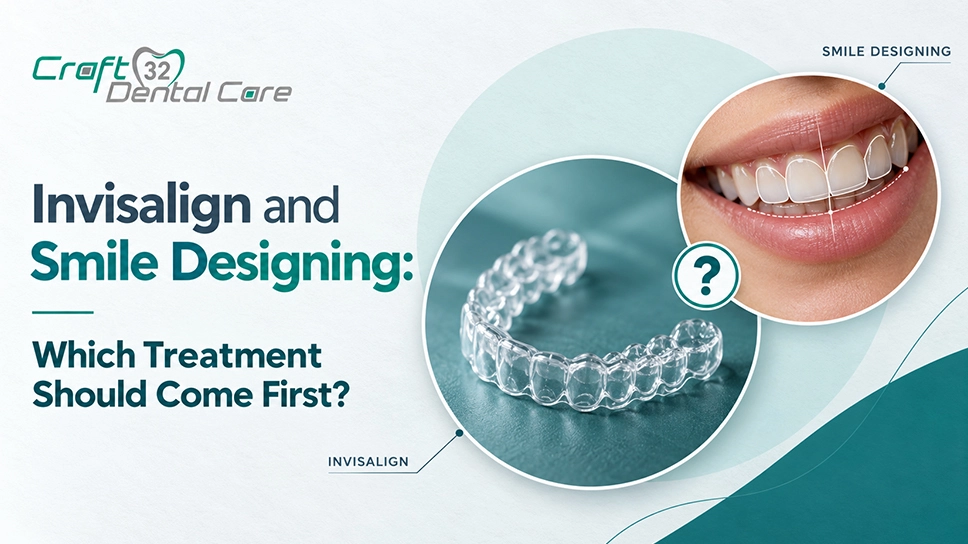
You want to improve your smile, but then the options start adding up. Invisalign, veneers, composite bonding, teeth whitening, gum contouring and complete smile designing can all address different concerns. So where should you begin?
For someone with crooked, crowded, spaced or uneven-looking teeth, one of the most important questions is whether teeth should be straightened first or whether cosmetic treatment can begin directly.
When considering Invisalign and smile designing, there is no single treatment order that works for everyone. Invisalign primarily changes the position of your natural teeth, while smile designing can address their shape, colour, proportions, gum line and overall appearance.
For some patients, Invisalign may provide a better foundation before cosmetic treatment. For others, smile designing without orthodontic treatment may be appropriate.
The right sequence depends on your tooth position, bite, gum health, existing restorations, facial proportions and what you actually want to change about your smile.
Invisalign and Smile Designing Are Not the Same Treatment
Although both can improve the appearance of a smile, Invisalign and smile designing work differently.
Understanding this distinction makes it easier to see why one treatment may sometimes be recommended before the other.
What Does Invisalign Do?
Invisalign is an orthodontic clear aligner system designed to gradually move teeth into planned positions.
Instead of fixed brackets and wires, it uses a sequence of removable transparent aligners. Each aligner applies controlled forces to specific teeth as treatment progresses.
Depending on the individual case, Invisalign may be considered for concerns such as:
- Crowded or overlapping teeth
- Gaps between teeth
- Crooked teeth
- General alignment problems
- Certain overbites, underbites and crossbites
The key point is that Invisalign moves your existing natural teeth. It does not primarily change their colour or reshape their surfaces.
At Craft 32 Dental Care, Invisalign and clear aligners in Chennai are digitally planned following an assessment of tooth alignment, bite relationship and overall dental health. The clinic states that it uses TRIOS 3 and iTero Lumina intraoral scanning systems for digital impressions and treatment planning.
What Does Smile Designing Do?
Smile designing takes a broader view of dental aesthetics.
Rather than focusing only on whether individual teeth are straight, it evaluates how the teeth, gums, lips and facial features work together when you smile.
Depending on the patient's concerns, a smile design plan may involve:
- Ceramic veneers
- Composite bonding
- Professional teeth whitening
- Gum contouring
- Orthodontic alignment
- Crowns or other restorative procedures in more complex cases
For example, a person may already have reasonably straight teeth but be unhappy with a chipped front tooth, uneven tooth lengths and discolouration. In that situation, orthodontic movement may not necessarily be the first priority.
Craft 32 Dental Care's approach to smile designing in Chennai considers facial proportions, lip dynamics, tooth proportions, gum aesthetics and tooth alignment as part of treatment planning.
When Might Invisalign Come Before Smile Designing?
There are situations where correcting tooth position first can provide a more suitable foundation for later cosmetic treatment.
Your Teeth Are Noticeably Crooked
If the main issue is tooth position, attempting to disguise significant misalignment using cosmetic restorations may not address the underlying alignment.
Moving the teeth first can allow the dentist to reassess their final shape, proportion and appearance once they are in more appropriate positions.
You Have Significant Crowding
Crowding occurs when there is insufficient space for teeth to sit in their ideal positions.
In suitable cases, orthodontic treatment can gradually improve their arrangement.
Once alignment has been completed, some patients may find that fewer cosmetic changes are necessary than they originally expected.
You Have Larger Gaps Between Teeth
Small gaps can sometimes be managed aesthetically using composite bonding or veneers.
Larger or multiple spaces, however, may benefit from orthodontic evaluation.
Rather than simply increasing the width of several teeth to close spaces, an orthodontic approach may redistribute the space more appropriately before any aesthetic refinements are considered.
Your Bite Also Needs Attention
Smile appearance is only part of treatment planning.
How the upper and lower teeth meet is also important. If there is an overbite, underbite, crossbite or another bite-related concern, the dentist or orthodontist may recommend addressing this before focusing on purely cosmetic changes.
Patients with these concerns can learn more about orthodontic treatment in Chennai, including braces and clear aligner options.
Alignment Could Reduce Cosmetic Alteration
This can be an important consideration for patients interested in veneers.
If a tooth is substantially rotated or positioned outside the ideal arch, placing a veneer directly may sometimes require more alteration than if the tooth were first moved into a better position.
In suitable cases, alignment before cosmetic treatment may therefore support a more conservative treatment plan.
That does not mean everyone considering veneers needs Invisalign. It simply means tooth position should be evaluated before the final cosmetic plan is made.
When Might Smile Designing Be Considered Without Invisalign?
Invisalign does not automatically need to come first.
If tooth alignment and bite are already acceptable, the concerns may be primarily aesthetic.
Minor Tooth Shape Irregularities
Some people have teeth that are naturally shorter, narrower or slightly uneven compared with neighbouring teeth.
Composite bonding or veneers may be considered to improve proportions without orthodontic movement when clinically appropriate.
Tooth Discolouration
Clear aligners move teeth but do not change their natural shade.
If the main concern is staining or discolouration, professional teeth whitening may be a more relevant treatment.
Small Chips or Worn Edges
Minor chips, worn edges and small differences in tooth length may sometimes be managed using bonding or veneers.
Small Gaps
A minor gap may sometimes be suitable for composite bonding or veneers rather than months of orthodontic movement.
The decision depends on the size and location of the space, tooth proportions and bite.
Uneven Gum Lines
If excessive or asymmetrical gum display is affecting the smile, gum contouring may form part of a smile design plan.
Moving teeth may not necessarily address a gum-line concern by itself.
Can Invisalign and Smile Designing Be Combined?
Yes. Invisalign and smile designing do not have to be competing choices.
For some patients, they can be different stages of one comprehensive smile treatment plan.
A possible sequence could look like this:
Consultation → Digital assessment → Invisalign or orthodontic alignment → Retention and stabilisation → Whitening if appropriate → Bonding, veneers or gum correction if required → Final smile refinement
Not every patient needs every stage.
For example, someone with moderately crowded and stained teeth may complete Invisalign followed by whitening and require no veneers at all.
Another patient may complete alignment but still have two undersized front teeth. Composite bonding or veneers could then be considered to refine their proportions.
A third patient may have good alignment already and move directly to whitening and bonding.
This is why treatment planning should begin with the problem being corrected, rather than with a predetermined list of procedures.
Invisalign Before Veneers
Veneers are thin restorations placed over the front surface of teeth to alter aspects such as shape, colour, size and symmetry.
They can be valuable in smile designing, but they are not an alternative to orthodontics in every situation.
Imagine that a front tooth is significantly rotated. Trying to make it appear straight only by changing its outer surface may require a different degree of tooth preparation than if the tooth were orthodontically repositioned first.
In an appropriate case, Invisalign before veneers can help place teeth in more favourable positions. The dentist can then determine whether veneers are still required and, if so, how much aesthetic alteration is necessary.
For someone with already well-aligned teeth but significant shape, surface or colour concerns, veneers may potentially be considered without prior Invisalign.
The choice should therefore be based on clinical assessment rather than appearance alone.
Invisalign and Teeth Whitening
Whitening is another treatment where timing matters.
During Invisalign treatment, the first priority is moving the teeth according to the orthodontic plan. Once alignment is approaching completion, the dentist can determine whether whitening should be incorporated into the wider smile makeover.
This becomes especially important when veneers, crowns or bonding are also planned.
Natural teeth can be whitened, but restorative materials do not respond to whitening in the same way. Establishing the desired tooth shade before choosing the final shade of certain restorations can therefore help create a more coordinated result.
The exact sequence varies depending on the treatment plan.
How Digital Planning Helps
Modern smile planning is not simply about choosing "straight" or "white" teeth.
The relationship between tooth position and the rest of the face matters.
At Craft 32 Dental Care, the Invisalign service uses digital scanning to create a 3D model and treatment simulation, while its smile design approach evaluates facial proportions, lip dynamics, tooth proportions, gum aesthetics and the smile arc.
Digital planning can help assess several factors.
Tooth Position
Digital scans provide detailed information about crowding, spacing and the relationship between individual teeth.
Bite
The way upper and lower teeth interact needs to be considered before aesthetic changes are planned.
Smile Proportions
The width, height and symmetry of visible teeth contribute to how balanced a smile appears.
Facial Harmony
A tooth that looks appropriate in isolation may not necessarily create the same effect when considered alongside the lips and facial proportions.
Treatment Visualisation
Digital simulations can help patients better understand the intended direction of treatment before proceeding.
Digital planning does not guarantee a particular outcome, but it can improve communication between the patient and dental team and support more individualised treatment planning.
How Long Does Combined Treatment Take?
Treatment time depends heavily on what needs to be corrected.
Invisalign generally requires more time because teeth have to move gradually and safely through a sequence of aligners. Craft 32 Dental Care currently states that its Invisalign treatment typically ranges from around 6 to 24 months depending on case complexity.
That does not mean every combined smile makeover will take that long.
Whitening, composite bonding and some other cosmetic procedures can often be completed over much shorter periods. Veneer treatment will have its own planning, preparation and fitting stages.
If orthodontic alignment forms part of the plan, it is usually the tooth movement that determines much of the overall timeline.
Patient compliance can also affect Invisalign treatment. Aligners generally need to be worn consistently according to the orthodontist's instructions for the planned movements to occur.
What Does Invisalign and Smile Designing Cost in Chennai?
There is no single price for a combined Invisalign and smile designing treatment because the term "smile designing" does not refer to one fixed procedure.
Two patients asking for a smile makeover may need completely different treatments.
The overall cost can depend on:
- Complexity of tooth alignment
- Number of aligners required
- Aligner system selected
- Duration of orthodontic treatment
- Number of teeth requiring aesthetic correction
- Whether bonding or veneers are used
- Number and type of veneers
- Teeth whitening requirements
- Gum contouring when indicated
- Additional restorative procedures
- Number of treatment stages
For this reason, comparing only a single package price can be misleading.
A clinical and digital assessment allows the dental team to identify which treatments are actually necessary and prepare an individual treatment estimate.
How Do You Know Which Treatment Should Come First?
Instead of asking, "Is Invisalign better than smile designing?", a more useful question is:
What is causing the part of my smile that I want to change?
If the problem is predominantly position, orthodontic treatment may play the larger role.
If the problem is predominantly shape, colour or proportion, cosmetic dentistry may be more relevant.
If you have both types of concerns, a combined plan may be considered.
Your dental team will typically evaluate:
Tooth Position
Are the teeth straight, rotated, crowded or spaced?
Bite
Do the upper and lower teeth meet appropriately?
Gum Health
Healthy gums provide an important foundation before elective aesthetic procedures.
Tooth Shape and Colour
Some concerns cannot be corrected by moving teeth alone.
Existing Restorations
Crowns, veneers, fillings and implants can influence the treatment plan.
Facial Proportions
The aim is to plan the smile in relation to the face rather than treating each tooth in isolation.
Your Expectations
What bothers you most about your smile? Straightness, gaps, colour, tooth shape, gum display or a combination?
Clearly communicating your priorities can help the dental team develop a treatment plan around your goals.
Long-Term Stability
Treatment planning should consider not only immediate appearance but also bite, retention, oral health and how the result will be maintained.
Invisalign and Smile Designing at Craft 32 Dental Care
Craft 32 Dental Care in Chennai provides both orthodontic and aesthetic dental treatment, allowing tooth alignment and smile aesthetics to be considered as parts of the same overall treatment plan when appropriate.
For Invisalign and clear aligner treatment, the clinic uses digital scanning and 3D treatment planning to assess alignment and planned tooth movement. Its smile design approach considers facial proportions, lip dynamics, tooth symmetry, gum aesthetics and functional bite alignment. (Craft 32 Dental)
The clinic's smile design options include ceramic veneers, composite bonding, professional whitening, gum contouring and orthodontic alignment when required. (Craft 32 Dental)
This means the starting point does not have to be "I need Invisalign" or "I need veneers." It can instead be a comprehensive assessment of what is contributing to the smile concern and which treatment, or combination of treatments, is appropriate.
Invisalign and Smile Designing Which Should Come First?
For some people, Invisalign before smile designing can establish better tooth positions before aesthetic refinements are made. For others whose alignment and bite are already suitable, cosmetic procedures may be considered without orthodontic treatment.
And sometimes, Invisalign itself may address enough of the patient's concern that fewer additional cosmetic procedures are needed.
The key is not to choose the treatment order based only on photographs, trends or another person's smile makeover.
If you are considering Invisalign and smile designing in Chennai, a clinical and digital assessment can help identify whether your concern comes from alignment, tooth shape, colour, gum position or a combination of these factors.
Considering a smile makeover? Book a consultation with Craft 32 Dental Care in Chennai to discuss your alignment and aesthetic concerns and understand which treatment sequence may be appropriate for your smile.